Systemic PGE2 reduction carries potential risks
PGE2 downregulation may increase EP-receptor imbalance in some patients (!)
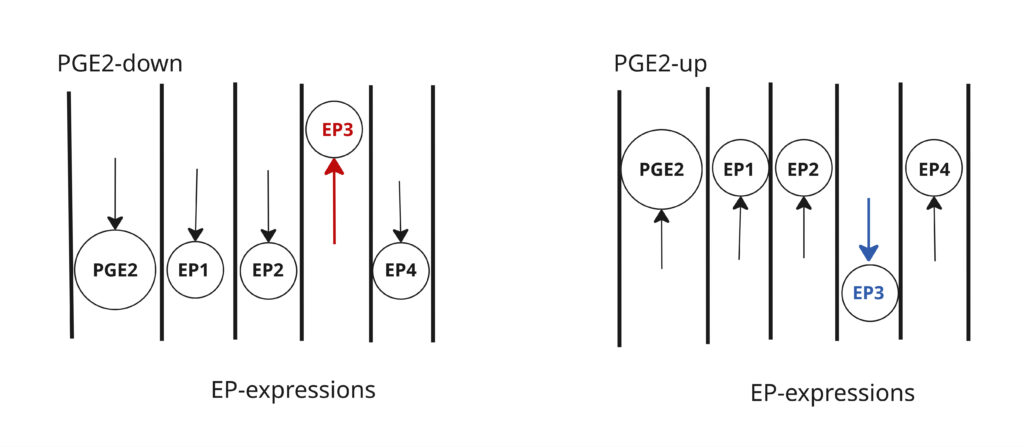
The following information is particularly important for the clinical implications of this hypothesis: systemic reduction of PGE2 may affect the balance of EP-receptor expression. PGE2 upregulation is associated with reduced EP3 expression and, in many cases, increased expression of EP1, EP2 and EP4.¹⁻³ With PGE2 downregulation, the opposite could be expected: EP3 expression may increase, while EP1, EP2 and EP4 expression may decrease. This could be beneficial for patients with an “EP3-down” profile, but potentially detrimental for those with an “EP3-up” profile, as the imbalance could be further amplified if EP3 expression increases even more.
A new perspective on NSAID side effects
NSAIDs reduce PGE2 production by inhibiting the enzyme COX-2, which also synthesizes other prostaglandins. They are known to cause adverse effects in some patients. Their lack of sufficient selectivity may contribute to this, but we hypothesize that a major factor may be that their effects on EP-receptor expression can be counterproductive in some patients.
The hypothesis that the “EP3-up” category may be particularly susceptible is supported by the fact that serious NSAID-related adverse effects are often cardiovascular or renal, processes that may be strongly influenced by EP3 signaling. EP4 activity, which is relatively reduced in the “EP3-up” profile, provides protection against gastric ulcers,⁴ another well-known complication of NSAID use that might therefore be more likely in patients with an “EP3-up” profile.
See for more information and references the page: “On NSAID side effects”
1 Haddad, A. et al. Prostaglandin EP1 Receptor Down-regulates Expression of Cyclooxygenase-2 by Facilitating Its Proteasomal Degradation. Journal of Biological Chemistry 287, 17214-17223 (2012). https://doi.org/https://doi.org/10.1074/jbc.M111.304220
2 Bonfill-Teixidor, E., Otxoa-de-Amezaga, A., Font-Nieves, M., Sans-Fons, M. G. & Planas, A. M. Differential expression of E-type prostanoid receptors 2 and 4 in microglia stimulated with lipopolysaccharide. J Neuroinflammation 14, 3 (2017). https://doi.org/10.1186/s12974-016-0780-7
3 Bilson, H. A., Mitchell, D. L. & Ashby, B. Human prostaglandin EP3 receptor isoforms show different agonist-induced internalization patterns. FEBS Lett 572, 271-275 (2004). https://doi.org/10.1016/j.febslet.2004.06.089
4 Takeuchi, K. & Amagase, K. Roles of Cyclooxygenase, Prostaglandin E2 and EP Receptors in Mucosal Protection and Ulcer Healing in the Gastrointestinal Tract. Curr Pharm Des 24, 2002-2011 (2018). https://doi.org/10.2174/1381612824666180629111227
References